


Every teacher has taught a version of Craig.
Craig was unfailingly polite, cheerful and never any trouble. He'd say good morning, rummage in his chaotic bag, settle into his chair, and waits for you to do the work. Faced with a hard question, he'd produce the first thought that arrives and, if it turns out to be wrong, he'd stops and waits for a fix. Asked to plan an essay, he'd writes three bullet points and puts his pen down.
He would, in the most agreeable way imaginable, play truant while sitting at his desk.
It is tempting to call this laziness. It is more useful to call it something a little more specific.
Craig was a 'cognitive miser'.
The 'what' of being a cognitive miser
Social psychologists Susan Fiske and Shelley Taylor gave us the term cognitive miser in the 1980s. It describes a general human tendency: we treat thinking as a limited resource and spend it as sparingly as we possibly can.
Richerson and Boyd put the evolutionary case more bluntly, arguing that animals are under selection pressure to be "as stupid as they can get away with". For the majority of human history, this was excellent advice. Scanning the tree line for predators and enemies was likely more useful for survival than deep, contemplative thought.
The pupils in front of us have inherited that mental machinery and brought it into a room where we would like them to think hard about isotopes or Hamlet. Too often, this can result in predictable failures for misers like Craig.
It makes sense, right?
There is an uncomfortable truth for teachers: for a teenager, hoarding mental effort is not a failure of character, but a defensible - even rational - reading of the situation.
Effort is finite, and it comes with an opportunity cost for us all. Every effortful thought spent on isotopes is not spent on the far more pressing business of their teen social world, which the adolescent brain is primed to find more rewarding and important. Meanwhile the returns on academic effort is uncertain, delayed, and hard to estimate in advance for carefree teens who are living in the moment.
Students can be poor judges of whether an hour of work will pay off. If you cannot predict the return, the rational move is to keep your mental money in the vault.
This manifests itself in the classroom in suboptimal learning strategies. They try the first method that comes to mind, and when factorising fails they do not switch to graphing or square roots. Instead, they simply stop. Then, to protect a fragile but vital self-image, they'll reach for the cheapest explanation available, such as: I can't do maths.
The miserliness is sensible in the short run but ruinous in the long run for students like Craig. The debt accrues quietly, but the bill arrives when vital exam results are published.
Characterising hard work
The obvious antidote would be a student with limitless appetite for effort. Of course, that student is vanishingly rare.
A better model is the rare, but real, James Scholz.
Between March 2020 and June 2021, Scholz sat in front of an old computer monitor, beside a wall of post-it notes, with a ginger cat called Mika presiding from the top of the screen like a Sphinx. All while James live-streamed himself studying. No stunts and no jokes. Just the pitter-patter of rain sounds playing to mask the noise (watch and listen to one of the sessions HERE). Thousands of students turned up to work alongside him.
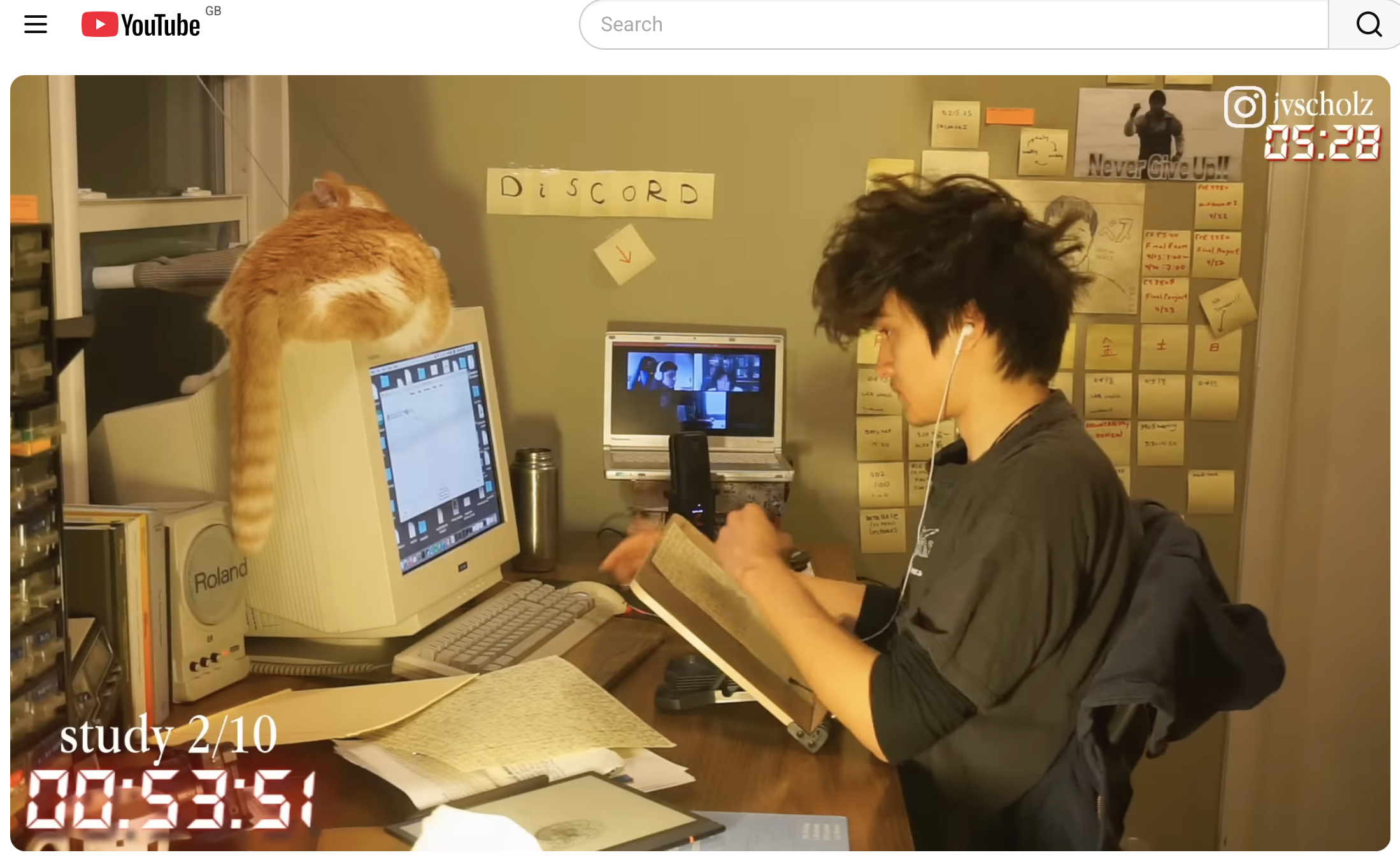
He ran a flashcard streak of 611 consecutive days, broken only when he uncharacteristically slept through his alarm.
The interesting thing about Scholz is not that he had more energy than everyone else. It is what he did with the energy he had.
Obviously, James was the opposite of Craig.
James restructured his environment so that resisting distraction cost him less mental energy. He automated the decision about what to do by making it the same decision every day. He used a small set of strategies, repeatedly, until they ran on habit rather than on taxing his willpower. He turned effort into a daily habit.
James resisted being a cognitive miser and the results were fruitful. For many students, even a fraction of the marathon study sprints would make a big improvement on their miserly practice.
What we have to teach
Independent study, or even doing the basics in the classroom, like reading or writing, need explicit instruction for passive misers like Craig. Three things have to be taught explicitly, because they are almost never acquired 'naturally':
How to be strategic and decide. Which strategy fits this task, how long it should take, and what should you do when it isn't working? Students typically know several strategies and have no idea how to choose between them, so they choose the quickest and easiest. Of course, they can have a stack of flashcards or flashy apps and not use them well.
How to learn alone. A secondary school student like Craig may spend over 1o00 hours on homework across five years. Most of it is set, but little of it is explicitly taught (the how and when). Independence is not what happens when we stop teaching; it is what remains after we have instructed carefully and modelled judiciously. We need to scaffold independence, including how to study and self-regulate outside the classroom, more often, and for longer than we might assume.
How to revise effectively. Rereading feels productive but it can prove near worthless if done badly. It is cheap. Conversely, retrieval and spacing are cognitively expensive, so pupils will not choose them unless we show them why the extra cost is worth paying.
When I think about Craig, I think I had an expert blind spot. I thought he could do these things because everyone could do these things if they just tried. Or I thought he was being resistant or plain lazy. He may indeed have been lazy at times, but when you understand the rational thoughts of a cognitive miser, you think more deliberately about how you can teach hard work in more specific, sustained ways.
Craig could have learned to work a little more like James and it could have made all the difference.
Related reading
- I have written about 'Improving independent learning' - HERE.
- I have written about 'Top 10 Revision strategies' - HERE.
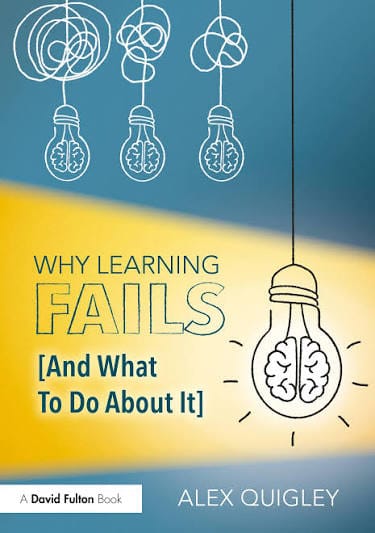
- Read about Craig, James Scholz, and much more in my book 'Why Learning Fails (And What to Do About It)' - HERE.

Comments