


The culture of reading is always changing. Currently, there are lots of articles about the death of reading and the 'dawn of a post literate society' to worry the average parent and the busy teacher. But what about the fate of deeper reading in classrooms across the country?
Are we entering an age of 'hasty reading', where AI summaries and slick videos supplant the more traditional, and challenging, reading that is stacked on shelves in the school library or next to the teachers' desk?
In new international data - the celebrated PISA tests by the OECD - there is a very obvious decline in reading standards across the world. See this helpful table here:
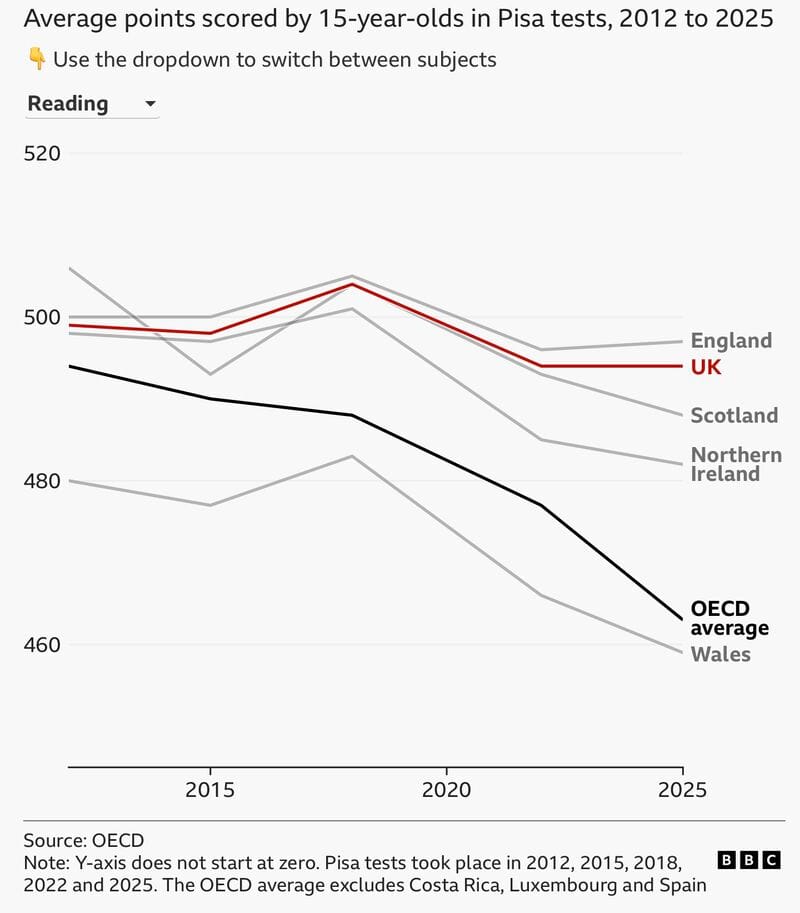
Data source: PISA 2025 results (volume 1). Article source: BBC
The results are stark and sad. Across all OECD countries, reading performance has fallen by the equivalent of around one and a half years of learning in the last decade alone. The drop has continued since COVID. According to the survey of adult skills from the OECD, adult literacy is falling too.
They identify "hasty reading" being on the rise. Pupils race through reading texts and make more mistakes. This isn't just struggling readers or those from disadvantaged backgrounds. Reading decline hits hard for the wealthiest families too. There is a deeper trend affecting all corners of the global and school types everywhere.
In England, we have stemmed the tide of declining reading, which is a call for positivity and also reflection. It is not the same crisis of 'hasty reading' as many countries, but we have stopped making progress too. Was the direction for early reading and phonics foundational for success in the last decade? Even as reading for pleasure declined, were teachers in England foregrounding reading for academic success in ways we need to learn from and sustain in future?
England has stemmed the tide, but we have stopped making progress. Challenging hasty reading may be our best bet. Understanding the phenomenon of 'hasty reading' is an important starting point.
Screen distraction?
Is technology and screen distractions the root of the issue with hasty reading? Have we traded in textbooks for Chromebooks too quickly?
The OECD data also reveals that one in four students reported classmates being distracted by devices in many science lessons. It is a case for getting mobile phones out of classrooms, but the presence of technological devices is only likely to be one of many reasons at the root of hasty reading.
Are pupils now beginning to consistently offload tricky reading onto AI chatbots? There is OECD evidence that over 40% of students are using AI to help draft school writing weekly or daily. It is a short leap to consider students avoiding demanding, deep reading and instead selecting a quick AI text summary to 'read' instead.
Evidence indicates that even experienced undergraduates can be inattentive with on-screen reading. Teachers can make a difference when reading in classrooms. Receiving feedback on digital reading can help, but under timed pressure (like in the PISA tests), screen reading seems to be more of a challenge and it leads to the hasty reading teachers worry about.
The fundamental changes in how children read through technology are likely at the root of a global phenomenon, alongside the broader impact of technology on how they learn and develop their knowledge too.
Can technology texts prove a valuable time saver?
The OECD evidence about a growing reading gap, and a heightening of hasty reading, looks back at the last decade. But as we look forward, the ascendency of AI is an area of both worry and potential promise.
What should we worry about concerning combining reading and AI? Using AI for generating class reading could prove a time saver, but we are in danger of creating AI summary reading that hollows out the complexity and sophisticated vocabulary that is needed for your average student to actually learn new things.
The hollow reading of AI texts can be challenged to mitigate any negative impact. We can insert vocabulary and issue richer, more specific prompts. But speedy expediency can also lead us to the natural pick up of quick, hollow reads that fit onto the span of a PowerPoint slide.
In saving time in the classroom, and our daily lives, by using AI instead of engaging in deeper reading and research, we could be hastening the death of careful, critical reading for good.
Now, there is only so much curriculum time to go around. It makes sense that reading is squeezed when you need to cover a topic in a couple of lessons. But speedy curriculum coverage, with only a diet of sanitised and shortened reading, is going to lead to shallow learning and remembering. A balance needs to be struck. Pulling a quick and easy text from ChatGPT every once in a while is fine if a broader curriculum of sustained, deeper reading is in place.
You are meant to find some reading hard. Some sentences don't make sense, but you read them again. You check back in the text. Then it starts to make more sense. This is the deeper reading that creates the level of friction and difficulty that children - both young and old - need to read to learn. In the rush for tech support, we cannot forget this enduring truth.
Putting an end to hasty reading
Almost everything written about hasty reading, the growing reading gap, or the 'end of reading' is rightly concerning. The dangers of shrinking attention spans, omnipresent phones, or degree level students struggling to finish novels should spur us into action.
Professor Tim Shanahan put it well:
"When it comes to reading comprehension, our job isn’t to smooth their way, to avoid and evade difficulty. No, we are responsible for making students powerful and independent, teaching them how to recognise and transcend linguistic and conceptual obstacles."
Professor Tim Shanahan, 'AI and the teaching of reading comprehension - Part 2'
We will only fend off a 'post-literate society', where hasty reading is the norm, by keeping difficult texts in front of the children who find them hardest to access and understand.
Teachers need to help their pupils find success, and joy, in reading that is slow, effortful and demanding, but also revealing, illuminating and even transformative. We need to help every pupil transcend the limits of their language. Hasty reading is not inevitable.
Related reading:
- The OECD PISA reports can be accessed HERE; while the England specific report is HERE.
- Professor Tim Shanahan surveys the slim evidence with a balanced account of 'AI and reading comprehension' - see HERE.
At the start of December, I am delivering a 'Literacy and SEND Teachology Masterclass' to support struggling readers and writers. It is both live in person and online (with innovative tech that ensures interactivity and easy access to resources). It is training for literacy leads, subject leaders, curriculum leaders, SENCOs and any colleagues looking to develop inclusive classrooms and improve outcomes. FIND OUT MORE HERE.

Comments