


Reading in class should be one of the richest experiences a teacher can offer. In practice, it can also prove one of the most uncertain and difficult. Whether it is reading a story in year 2 or unpicking historical sources in a year 8 history lesson, teachers can frequently find themselves less surefooted that in many other aspects of their teaching practice.
The problem has been growing for a number of years. Too many teachers have been shaped, often unknowingly, by a default mode of reading instruction: the short extract followed by the obligatory worksheet. Booklets with comprehension questions focused on quick and easy quiz responses. Or the annotation task that substitutes for genuine discussion.
These approaches are not without some merit, but as a reading diet, they can be impoverished. They train students (and teachers) to do something quite different from the adaptive and intellectually rich classroom talk that characterises genuine reading engagement and deep understanding.
When teachers move beyond the extract-and-question routine, or unmoored from the PPT slide deck, they can find themselves somewhat adrift.
What do you actually say when a class has been reading a chapter of a novel or a science textbook? Which questions do you ask first? When do you push for debate, and when do you pause to consolidate? When do you stop and check understanding when you read a textbook chapter?
Introducing the R.E.A.D.S. Framework
The R.E.A.D.S. framework offers a useful set of prompts to anchor classroom reading and bring more conscious intent from busy teachers to do it well:
R – Review prior knowledge and make predictions
E – Explore text meanings and clarify understanding
A – Identify anchor points to stop and discuss
D – Debate alternative meanings and competing views
S – Summarise to consolidate understanding
It is not a rigid sequence to follow step by step, but a flexible repertoire. It is a helpful prompt for the teacher to consider which mode of discussion is most valuable at any given moment.
This poses a challenge when you have a class with diverse reading abilities. A ready-made worksheet is reassuring because it makes the decisions for you. The questions are pre-determined. The order is fixed and the 'right' answers are usually implied.
By contrast, deploying R.E.A.D.S. well, requires a teacher to make real-time, adaptive decisions: Where are the students? What does this passage most demand? Are we ready to debate, or do we need to clarify vocabulary first?
Last week, working with teachers and leaders in Slough, I heard about teachers early in their careers who – unused to extended reading in the classroom – can find it difficult and avoid it altogether. It is not a failing; it is a skill that needs deliberate development.
Consider a year 9 history class reading a primary source on the causes of the First World War. A teacher might be tempted to leap straight to debate — 'Was one country more responsible than others?' — but if students haven't yet untangled the language of the source itself, the debate will be hollow. The E of the framework — exploring meanings, clarifying understanding — should come first. Once the text is clear, D can do its proper work.
Using the R.E.A.D.S Framework
The good news is that R.E.A.D.S. is learnable, and it becomes more intuitive with practice. A few starting points are useful:
- Plan your anchor points in advance. Identifying moments to stop and discuss needn’t always be spontaneous. Marking up a text before the lesson with two or three pause-points gives you a structure to fall back on, while still leaving room for responsive discussion.
- Vary the entry point deliberately. Sometimes it makes sense to begin with R and activating prior knowledge before reading begins. Other times, diving straight in and pausing at a moment of textual difficulty with E is more powerful. Being intentional about your starting point is itself a form of expertise.
- Use the framework to stretch, not just support. Debating alternative meanings and competing views is where students are pushed to think hard. For students who have been trained on comprehension worksheets, this can feel disorienting at first. Persisting with it builds the habits of thinking that genuine reading requires.
The R.E.A.D.S. framework won't do the work of building understanding tricky classroom reading for you. But it can prompt you towards the kinds of questions and discussions that lift reading from a passive exercise into something far more intellectually alive and impactful for every student.
If you want to read about R.E.A.D.S then invest in my new book, 'Literacy Essentials for Every Teacher' - at Amazon HERE & Routledge HERE.
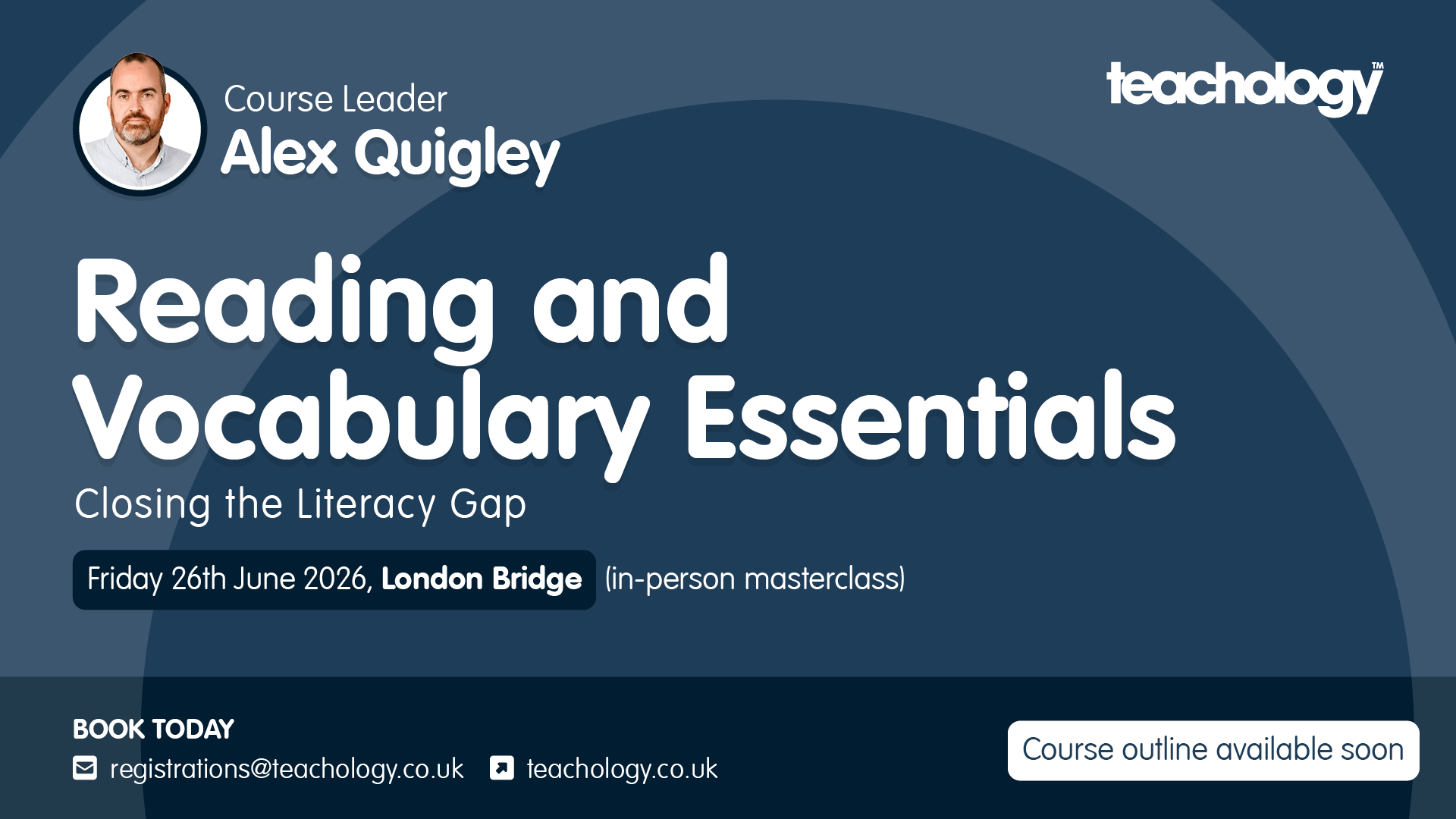
Do you want to unlock reading in class with in-depth support? On Friday the 26th June, I am doing an exclusive 'Reading and Vocabulary Essentials' masterclass for Teachology at London Bridge. In this masterclass, I explore the R.E.A.D.S framework in depth, along with lots of other practical strategies for teachers across a range of phases to teach reading and vocabulary with success. FIND OUT MORE HERE.

Comments