


High-quality talk routines in the classroom matter. They can build understanding, foster engagement, aid behaviour, promote critical thinking, and much more. It is no surprise then that oracy has risen to prominence once more given the potential benefits of purposeful classroom talk.
But year after year, we see evidence that teachers can struggle with classroom talk, or feel it isn't maximised. Lessons plans can limit purposeful talk, knowingly or unknowingly. It seems like the most natural thing to orchestrate - and it can be for an expert teacher - but it is actually a challenging, subtle and tricky practice to get right.
Schools can be busy promoting occasional set-piece debates to develop oracy, but actually miss the countless daily opportunities that promote high quality talk. Done routinely, they can accumulate quietly in the background, without the grandeur of an 'event', but they build like vital savings in the bank. They form habits of thinking and beneficial routines.
As Tom Sherrington states:
"It’s important to have practical classroom routines you use all the time so that students’ daily diet of learning has challenge, oracy, agency-building built in; this is how habits form and how cultures are shaped."
'Oracy? Challenge? Student Agency? A three-way approach to integrating curriculum elements of this kind'
Tom routinely promotes daily practices like 'Think-pair-share'. Doug Lemov, in the ever-popular 'Teach Like A Champion' series, explores 'Turn and Talk' and 'Habits of Discussion'. Voice 21 'Oracy Benchmarks' also address key aspects of talk in similar ways. They all cover similar ground. They name routine, valuable practices that scaffold talk so that it is likely to be more effective.
What is clear is that talk routines need to be explicit, well-practised with students, with clear goals and roles.
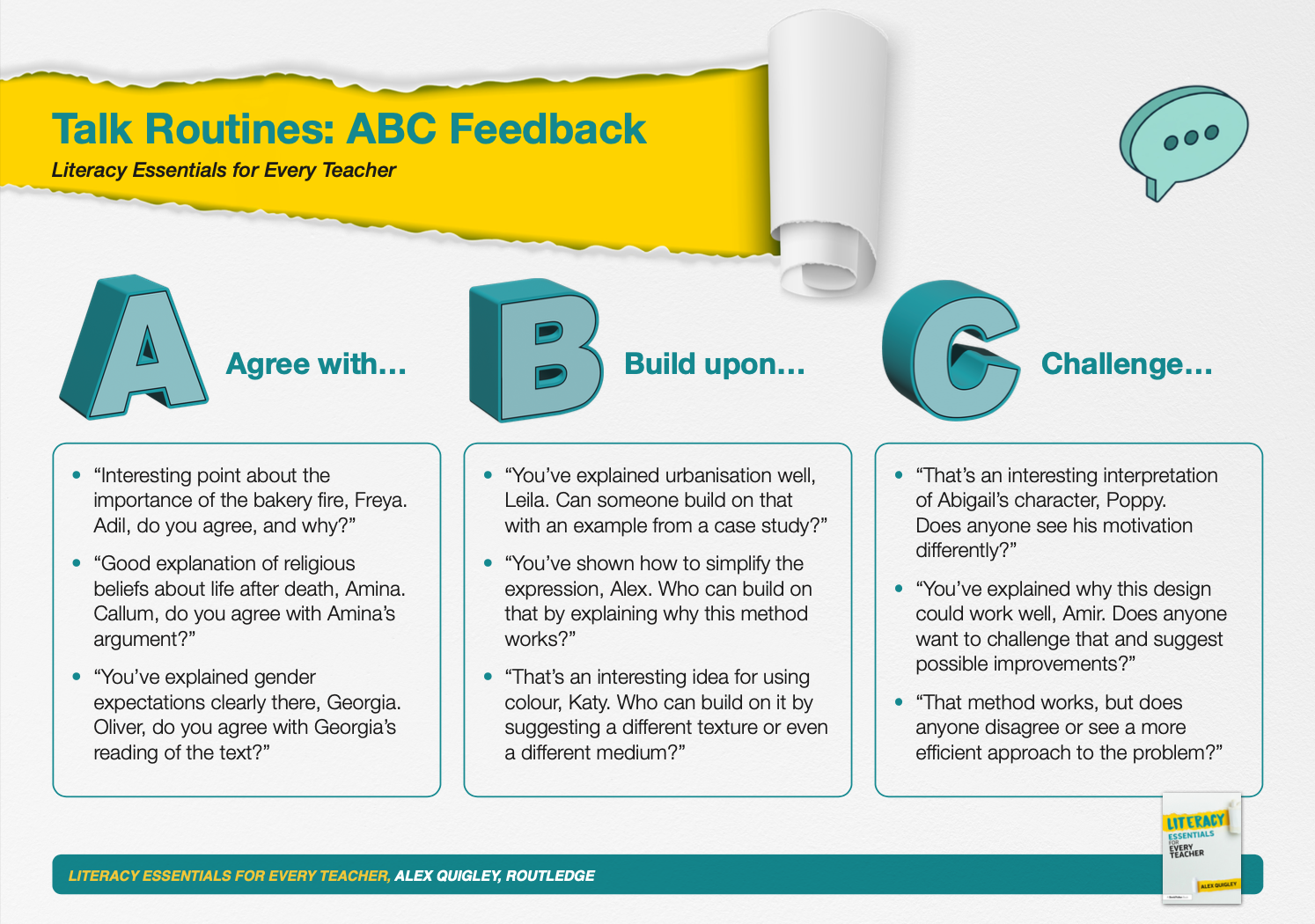
ABC Feedback
My favourite teaching strategy that creates a compelling talk routine is ABC feedback. I've been promoting this approach for well over a decade (I first wrote about it in 2013), after finding it so useful as a routine structure for my own classroom.
You can find a free ABC Feedback summary resource based on my new book, 'Literacy Essentials for Every Teacher' on my RESOURCES page HERE.
What ABC Feedback does, akin to 'Habits of Discussion', is to promote accountable talk. That is to say, students are accountable to listening to the ideas and views of one another. Done well, this approach promotes more active listening, more focus and attention on task, and therefore more learning.
There is some solid research on how this aids learning. 'Accountable talk' is a 'thing'! Lauren Resnick describes 'accountable talk' in the following way:
Accountability to the learning community
Students listen carefully, build on one another’s ideas, ask clarifying questions, and disagree respectfully.
Accountability to knowledge
Claims should be accurate and supported with evidence, facts, texts, or disciplinary appropriate ways.
Accountability to rigorous reasoning
Students explain their thinking, justify conclusions, and aim to use logic rather than unsupported opinion.
There is lots going on in each phrase here for teachers. What exactly does 'listen carefully' entail? How do we best 'build on one another's ideas'? Who should we target opening questions to? and more.
It helps to foreground what do we mean by 'active listening', and for specific phases or subjects, what would be an appropriate use of evidence, logic or opinion.
What would success look like? Teachers could monitor how many discussion turns takes place, or the number of points students use in their contributions. They could consider how the reasoning of students - beyond consider their side of the argument - occurs. They can be subtle but significant inferences about student understanding and knowledge building.
Simply trying and sustaining ABC feedback doesn't mean every talk activity goes well. Sometimes truculent teens don't feel like disagreeing respectfully or justifying their conclusions with careful evidence! But the structure does provide clarity and offers a starting point for more accountable classroom talk.
Related reading:
- Find a helpful guide to 'Accountable Talk' from UNESCO: HERE.
- Grab a copy of my new book, 'Literacy Essentials for Every Teacher' HERE.

Comments