


The start of a new school year has a familiar magic to it. New classes, new exercise books, and shiny new resolutions. It is the natural moment to try small, deliberate improvements to teaching that can stick for the year ahead. Vocabulary instruction can offer a meaningful and manageable starting point.
So, here’s how you can make your vocabulary teaching a little more glamorous.
Now, I recognise 'glamour' may seem a weird fit for the daily craft of the classroom, but actually the word tells a compelling story. Did you know that 'grammar' and 'glamour' actually share a family history? 'Grammar', in the fourteenth century, had a variant, 'gramarye', meaning 'learning and erudition', which became aligned with 'magic and enchantment'. To the illiterate majority of that era, the few who could read and write appeared to possess magical powers.
'Glamour' emerged as a Scottish variation of 'grammar'. It later took on the sense of a 'magical beauty and charm'. A witch would 'cast a glamour' – an illusion or spell.
In short: knowledge of language was magic. For our pupils today, it still is.
Every teacher who unlocks academic vocabulary for a child is casting a sort of spell and revealing meaning where before there was only meaningless jargon. I have written before about telling stories about words. Daniel Willingham has described stories as ‘psychologically privileged’ in our minds, and the story of ‘glamour’ can embody that psychological notion.
So, in that start-of-year spirit, here is a practical experiment: take the word 'glamour' itself and use it to rehearse a repertoire of vocabulary teaching strategies. Each strategy then transfers to the high-value academic vocabulary of your subject – 'photosynthesis', 'erosion', 'tyranny' – whatever words matter most for the lessons ahead.
1. Start with the story (etymology). Begin with the tale told above: grammar, gramarye, grimoire, glamour. Etymology can help converts an abstract label into a concrete narrative, and words with histories can prove far harder to forget even for the most truculent of teens along with curious youngsters.
2. Break it down and build it up (morphology). Words live in families and break into meaningful parts. From 'glamour' we can build 'glamorous', 'glamorously', 'glamorise', 'unglamorous'. There is even a sneaky spelling lesson lurking here: watch the 'u' vanish in 'glamorous' (a pattern shared with 'humour' and 'humorous'). The most valuable word roots open up a whole family of related words, along with an access point to new, unknown words too.
3. Grow a 'word tree'. One way to develop the branches of a word family is to create word trees - a simple graphic organiser. From the Greek 'gramma' – 'that which is written' – we can grow 'grammar', 'grammatical', 'glamour', can stretch further to 'telegram', 'diagram', 'anagram' and 'epigram'. Sketched quickly on the board, a word tree makes visible a rich network of words and it reveals how one root can unlock countless related terms.
4. Explore synonyms and antonyms. What similar words to 'glamour' can illuminate pupils' writing? They could compare 'charm', 'allure', 'elegance', 'enchantment', or contrast them with 'drabness', 'dullness' and 'plainness'. The discussion about layers of meaning are key. Can something be elegant but not glamorous? Is 'enchantment' more magical than 'charm'? These deliberate comparisons develop the depth of word knowledge that a glossary definition alone cannot reach.
5. Build a word gradient. Arrange near-synonyms along a line of intensity: plain → pleasant → attractive → stylish → glamorous → bewitching. Pupils can explore or argue about their order, and in so doing, draw out fine shades of meaning that dictionary definitions seldom infer. Gradients can work brilliantly for the evaluative vocabulary of essays too: think 'suggests → conveys → asserts → proclaims'.
6. Complete a Frayer model. Finally, consolidate with that trusty four-box grid: a definition in the pupils' own words; essential characteristics; examples ('the glamour of a film premiere'); and non-examples ('a wet Tuesday bus stop'). Non-examples do quiet but important work, marking the boundaries of a word's meaning. Of course, a Frayer model should be malleable. Swap out non-examples for 'synonyms', or 'themes' etc.
These strategies matter more than this single word. They can foster a curiosity for vocabulary that becomes an attitude that pupils can apply in every lesson for any subject or topic.
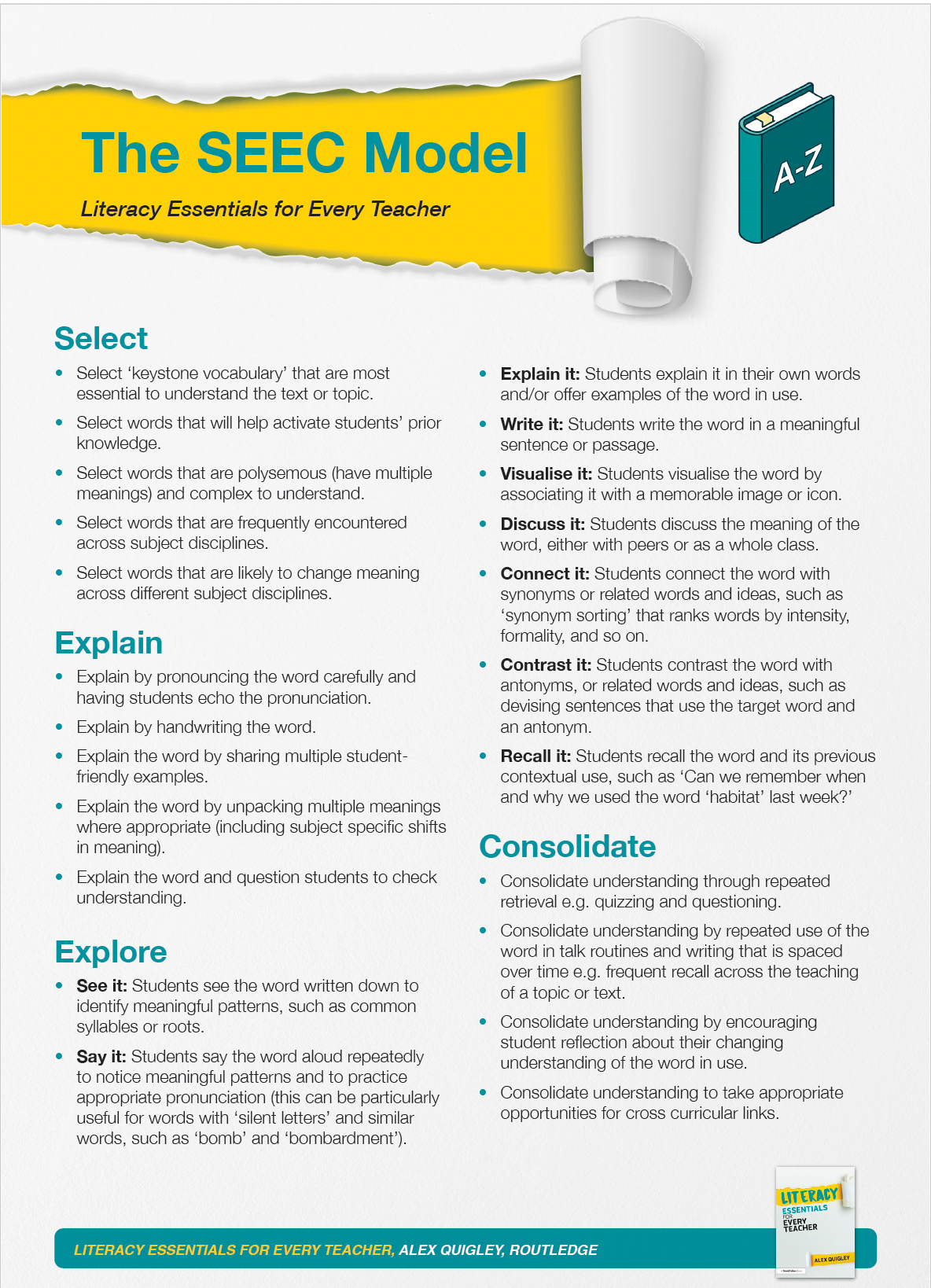
What I am really describing is the 'explore' phase of vocabulary teaching – going beyond quick definitions to examine a word's history, parts, family and near-relations. It is a myth that vocabulary simply grows by itself, or that glossaries and dictionaries do the job for us. Deep word knowledge comes from this deliberate, structured exploration, and it benefits every child, not just those who struggle.
David Crystal called his history of English grammar, 'Making Sense: The Glamorous Story of English Grammar'. He used the same pun that I've mangled in this blog. He too shows how potentially dry, lifeless learning attached to word lists can be transformed by the power of stories and a little structured word play.
The next time a pupil bemoans the dullness of teaching tricky academic terms, you can regale them with the tale of the glamorous Scots and their interest in the occult, and much more too.
Find my free vocabulary instruction SEEC model tool on my resources page HERE (sign up needed).
Read my blog about 'Select vocabulary to teach' HERE.
Read my blog about 'Why 'word consciousness' matters' HERE.

Comments