


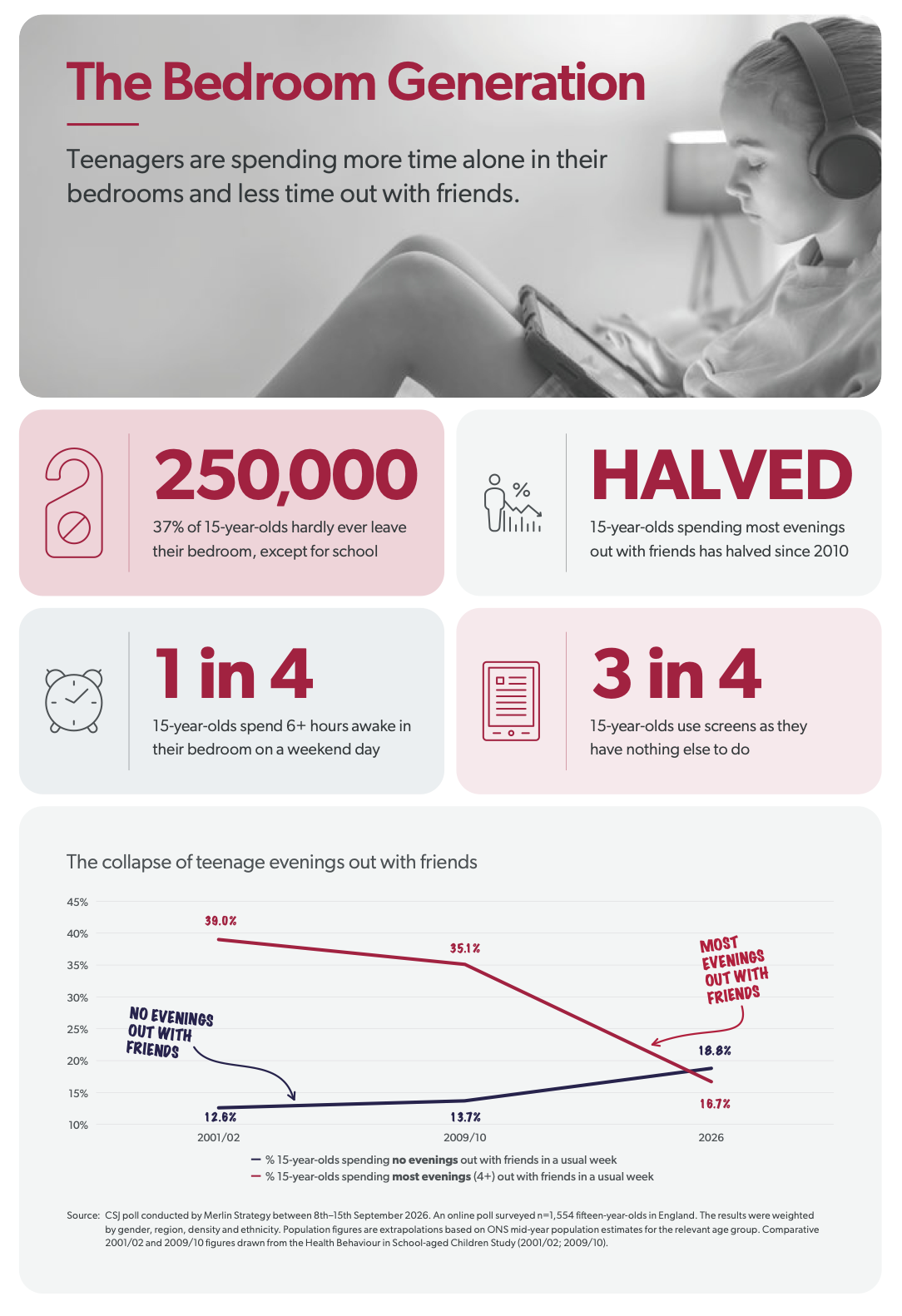
Around one in four 15-year-olds spend 6 hours or more in their bedroom on a typical weekend day. Consider that for a moment. These teens, hidden away in their bedrooms, often tethered to the blue-light of dopamine spiking devices, have been labelled a ‘bedroom generation’.
New research by the Centre for Social Justice, entitled ‘Inactive Nation (part 2)', details depressing insights into the shrinking experiences of young teens in England.
It is easy to fall for a heady mix of nostalgia and tales of a lost childhood, or bemoan how technology has stolen the innocence of the nation’s youth, but each insight in the study details a real loss we should consider. Evenings with friends have slumped in the last decade. Not only that, but a third of 15-year-olds stated they hardly ever leave their bedroom, except for school. Connection and belonging appears to have shrunk to the narrow confines of the bedroom.
Parents and policy makers will no doubt recognise the issues revealed by the data and how it may be linked to worsening mental health, or the grim finding that teenagers in the UK are the unhappiest in Europe.
No place to go?
Policy makers should consider how local youth services being eviscerated over the last decade of government has contributed to the situation. Between 2010 and 2023, spending was over a billion lower. Pounds mean places to go; cuts lead to locking kids in their homes for longer.
Between 2010 and 2023, local spending on youth services in England fell by 73% to £1.2 billion lower now than in 2010. In a similar period, more than 760+ youth centres were closed. Youth clubs, community library, school budget cuts, funded sporting places, all gutted so that only the wealthy were likely to have easy access to places to make friends, have fun and belong.
Beyond the gutting of important services, parents make key decisions too.
Parents might consider how the norms of letting kids out to be with friends has shifted and inadvertently trapped kids in their bedrooms. Teens want more face-to-face time with friends, but consistent polling shows that parents are reluctant to let children out until they’re older and the norm has shifted. If a few parents resist, plans breakdown, and online gaming or endless phone messaging can take over.
The current policy response
The current government recognise a deep-seated social challenge. As a direct response, the National Youth Strategy is a commitment of 500+ million over a decade. It recognises the links between loneliness and mental health, an active lifestyle with well-being and happiness.
Just some of the strategy proposes the following:
- Two headline targets for 2035. Halve the participation gap in enriching activities between disadvantaged young people and their peers, and give half a million more young people access to a trusted adult outside their home.
- Rebuild the youth workforce. £15 million over three years for youth workers, volunteers and other trusted adults — responding to the loss of more than 4,500 youth worker roles over the past decade.
- Young Futures Hubs. A £70 million programme over three years to help local areas support young people and develop up to 50 Young Futures Hubs by March 2029, which will include mental health support.
- Chosen trusted adults. Young people will be able to choose their trusted adult, and adults will receive training, including on safeguarding.
- New youth spaces. A commitment to create a new generation of welcoming spaces outside school or home — community centres, libraries, parks, youth clubs — where young people can stay active and make friends.
- Local coordination. Over £5 million across three years to support collaboration and partnerships between youth organisations locally and regionally.
Of course, some of these changes are commendable and should be supported to be implemented well. But 50 Hubs won't replace 750 closed youth centres.
Schools being incentivised to support 'enrichment' and extracurricular activities is more manageable than shifting complex social norms with parents at home, or directly addressing teen habits with technology, but if it doesn't come with substantive funding, it is likely to be on the margins in terms of making an impact.
Education and belonging
Schools can do a lot, but they cannot compensate for society. Finding spaces for sport and clubs and offering alternatives to bedrooms tethered to devices is necessary, but at the same time, the onus cannot all be on schools.
It is common, and understandable, in schools and colleges to hear about a focus on belonging right now. In part, it is a response to issues with attendance that have troubled educators since the pandemic, alongside the widely-recognised spike in mental health issues and falling well-being. It is also a response to the lived experience of their teen students.
I’ve written before about 'the challenge of belonging'. I think if we focus on clearly understanding how we can develop belonging in schools and colleges it will do the part education can play. I pose the following elements of a meaningful and manageable framework:
Providing opportunities for social belonging.
Nudging attitudes and beliefs about belonging.
Developing curriculum and belonging.
Developing teaching practices and belonging.
Developing behaviour and belonging.
But, ultimately, we need to have a shared accountability when it comes to helping teens not get trapped in their bedrooms, tethered to their mobile phones. It starts in the home with parents. It requires local and national government support, and a rebuild of the youth system and even some of our lost social fabric. Schools can help too, but the priorities need to be in order: parents, policy makers, school teacher and leaders.
In so doing, we can free a 'bedroom generation' to be healthier and happier.

Comments