


Key stage 3 (KS3) in secondary schools has always been the squeezed middle when it comes to school improvement. Jammed between high stakes assessments in KS2 and GCSEs at KS4, it has often been shrunken and or jammed-full with GCSE practice, and rendered an afterthought for curriculum design, staffing, and more.
The KS3 RISE Alliance appears to be a significant attempt by the government to foreground the importance of KS3 once more.
Leaders of the KS3 RISE Alliance, Lesley Powell and Rebecca Boomer-Clark, promote KS3 as a distinctive phase deserving greater attention:
"That is why there is a growing recognition across the sector that KS3 should be treated not simply as a bridge between primary school and GCSEs but as a distinct and purposeful phase of education in its own right."
'The Missing middle: Why we agreed to chair the Key Stage 3 Alliance'
One of the key areas of focus is on, "strengthening foundational skills to pave the way for GCSE success".
Of course, literacy skills such as reading, writing, academic vocabulary and talk, are central to accessing the secondary school curriculum. If you cannot read or write fluently you are locked out of the curriculum and academic success is inevitably denied (of course, this isn't new - the EEF was researching the 'reading at the transition' issue back in 2017).
Success in geography, biology, mathematics, history or design technology depends not simply on subject knowledge, but on the ability to access increasingly complex texts, instructions, explanations and sophisticated subject vocabulary.
Without secure literacy foundations, academic success is denied long before GCSE examinations or intensive interventions begin.
What literacy challenges at KS3 need solving?
The literacy challenge at KS3 facing schools is substantial. Reading habits and writing habits outside the school gates have declined dramatically compared to previous generations, whilst the literacy demands of the curriculum have only intensified with a mountain of exams at GCSE.
Compelling research from Professor Jessie Ricketts highlights the steep vocabulary and reading 'jump' that students experience on entering secondary school. Meanwhile, work by Professor Alice Deignan and Marcus Jones demonstrates the sheer scale of linguistic change pupils encounter in Year 7, where students may face up to four times as many new vocabulary items as they did in primary school.
In a world where teen students prefer TikTok to Tolkien, their ability to access the secondary school curriculum becomes acutely sensitive to effective and explicit teaching of academic language.
But it is all too common for secondary school teachers to be undertrained to address language demands. A geography teacher may assume pupils can interpret dense explanatory prose. A biology teacher may expect students to decode abstract scientific terminology, as they push through topics to get to the next assessment.
Yet, too few secondary teachers have received explicit training in recognising or addressing the nuanced literacy barriers students face in their subjects. The DfE has produced helpful guidance for 'Supporting reading in secondary school', but we need to remember that a focus on KS3 is the squeezed middle. In reality, it means that few teachers are granted the time and training to explore and address the academy language issues.
If students have writing issues - which clearly has an impact on subject success across the curriculum at KS3 - seldom gets any real attention.
The new year 8 reading test may shift attention when the new curriculum comes around, but concurrent training and support for teachers regarding literacy skills like reading is necessary if we are to shift practice and secure curriculum access in a sustainable fashion.
What are the solutions to securing strong literacy foundations at KS3?
A helpful starting point is to support all teachers to understand both reading and language challenges at the transition into Key Stage 3. Alongside this, schools and department teams translating 'disciplinary literacy' to their school is likely to be helpful.
The areas of literacy teaching and learning I think are most actionable and manageable for busy secondary school geography or science teachers include:
- Scaffolding complex texts. Tackling challenging, sustained reading of complex texts, whilst many students struggle, is typically avoided by time poor teachers. Instead, we simplify reading demands and slim down reading to a few image-laden slides in the name of dual-coding. We need to support teachers to break down a tricky text into parts, engage in high quality talk about the text, check understanding of vocabulary, and much more.
- Embedding reading fluency into every lesson. Reading fluency - the act of reading aloud with accuracy and expression - is enacted daily, or not, in secondary schools. Every time a teacher choose to read, or selects a reluctant reader, they are making a decision about reading fluency. These need to be intentional and based on sound evidence and principles for reading development (especially for the quarter of struggling readers who begin KS3 underprepared for the demands of accessing the curriculum).
- Vocabulary instruction. Most teachers are confident they teach vocabulary, but then the evidence shows that strategies for breaking down words and building them up, such as morphology instruction, is not well understood or enacted. We have seldom 'done' vocabulary at a school level. It needs systematic and sustained training. With a new curriculum around the corner, revisiting how to explicitly teach vocabulary, how to address tricky words during reading, and how to encourage independent word learning, will once again prove essential.
- Supporting and scaffolding struggling writers. Writing is one of the most demanding acts we learn as humans. The scale of the challenge for many students is immense. We need to help teachers understand that challenge, as well as how to scaffold key skills such as spelling, sentence composition, editing and revising, alongside the disciplinary writing moves the subject demands. This explicit teaching of writing is vital but too often lacking in KS3 classrooms.
- Structured talk routines. There is interest and momentum attending a focus on 'oracy', but too often - in secondary schools - enthusiasm doesn't translate into sustained, high quality talk routines. Too much engagement from lively teens in a debate can inhibit even experienced teachers, while loose talk without apt language scaffolds can prove ineffective. A coordinated approach to structured talk cannot unlock understanding of tricky texts, enhance writing, and help reasoning and simply improve all learning. Research evidence show this is hard to do well and requires support and training, but it can be impactful.
'Strengthening foundational skills' is a laudable aim, and KS3 is a necessary and valuable time to do so, but implementing it effectively will take sustained support and concrete actions.
KS3 has always proven the squeezed middle. Without significant and concerted action, even when the new curriculum and assessment work begins, it will still be pushed to the side when it comes to school improvement priorities. It is time to build alliances, develop evidence and resources for change, and act.
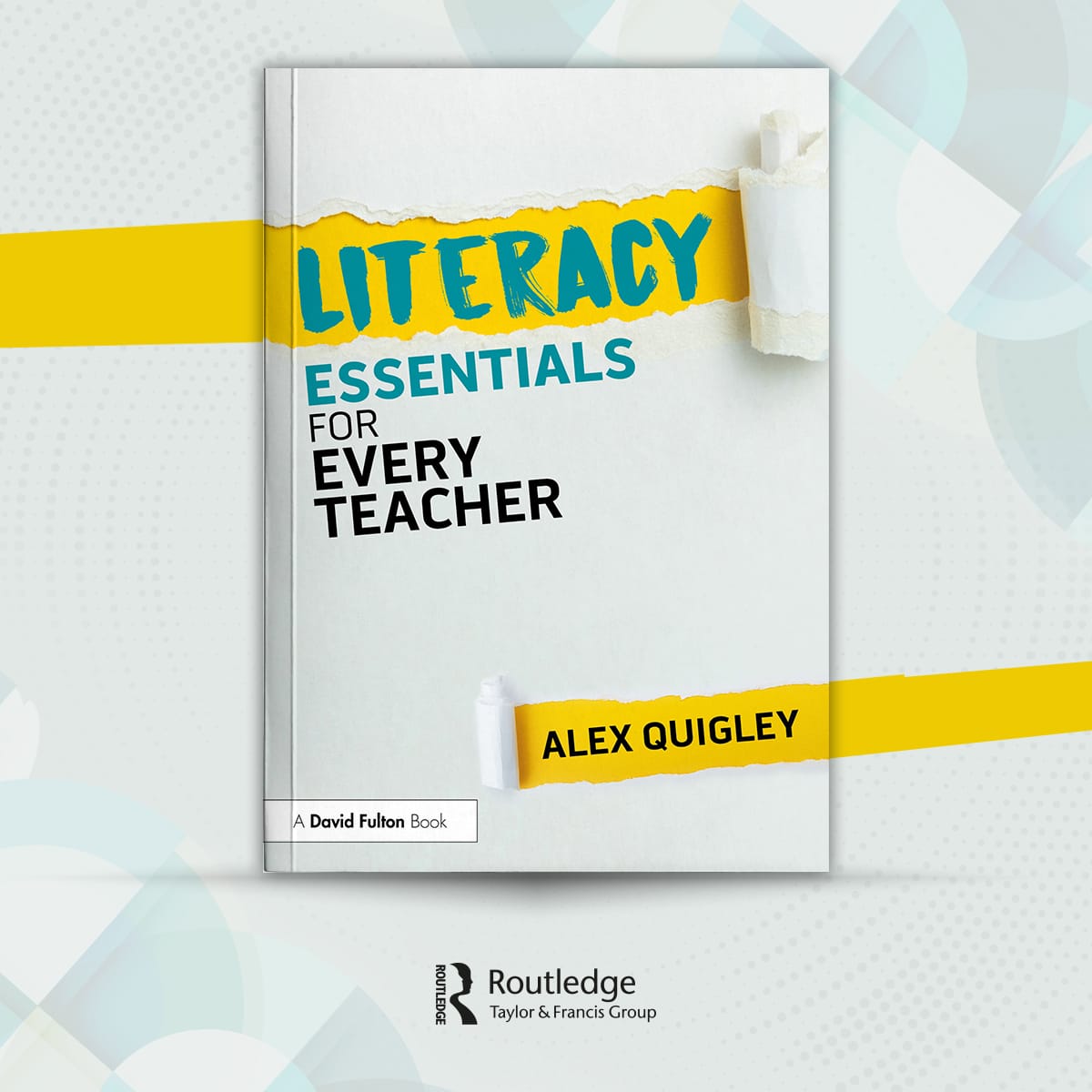
It would be remiss of me not to suggest that investing in my new book, 'Literacy Essentials for Every Teacher', would be helpful for busy teachers. Find it on Amazon HERE and Routledge HERE (currently 25% off if you buy 3 or more).
You can find free, new resources related to the book HERE.

Comments