


More than 1.8 million children in England are now identified as having special educational needs. That is more than one in five, and it has risen every year since 2016.
Among the large majority of them, the children on SEN support, rather than those holding an education, health and care plan — the most common primary need is speech, language and communication. A quarter of pupils.
In plain terms, one of the largest group of children we describe as having special educational needs are children who find communication, talking and understanding words difficult.
Among pupils with an education, health and care plan, communication needs come second only to autism. Developmental Language Disorder (DLD) alone affects something in the region of one child in fourteen.
So we should be clear about what we prioritise: literacy is not a helpful addition to inclusive practice. Instead, it is the daily life of a mainstream classroom and it is most of what inclusive practice is.
Language development and literacy skills are the source of nearly everything else we ask children to do in schools – academic or technical.
What the labels have in common
The book I have just finished includes pen portraits of common special educational needs: what they are, the barriers they typically create, and the literacy strategies that tend to help. Writing them was clarifying, because the same challenges kept reappearing.
A child with a dyslexic profile can struggle to decode and to spell, and then, over years of reduced reading experience, they can accumulate less vocabulary and less background knowledge than their peers. Over time, reading problem quietly becomes a knowledge problem and often a motivation problem too.
A child with DLD may follow neither the teacher's instructions nor a friend's joke. She may be quiet, or she may be argumentative: either way, she may be described first in terms of her behaviour and only later in terms of her language barriers.
A child with ADHD could lose the thread of a long explanation and struggle to sustain attention across an extended writing task. Both of which are, in practice, literacy tasks.
Different diagnoses, different causes, and no single, straightforward fix. But the barriers can surface in the same four places: reading, writing, talk, vocabulary – again and again. Teachers experience this shift and it makes it harder for pupils to access the academic curriculum.
The curriculum arrives in print
The literacy demands of the curriculum can sometimes get underestimated in secondary schools. This can commonly occur when subject teachers reasonably think of themselves as teaching history or chemistry rather than reading.
But the curriculum has no other route to understanding than in language. It arrives as a text to be read, a diagram to be interpreted, an explanation to be listened to, or an answer to be written down.
A Year 2 child may know perfectly well how to take away seven from fifteen and still not know what he has been asked because he cannot work out what 'altogether' is doing in the sentence. A Year 12 student may have everything she needs for an essay on religious beliefs and still hand in a weak argument that isn't joined up by language (whereas, nevertheless, it might be argued).
Access to the curriculum is, almost always, access to its language.
A well-intentioned problem
If we are not careful, inclusive teaching and literacy could spin off as separate 'specialisms' That don’t meet in the classroom.
Already, literacy issues can too often be assumed to be getting dealt with in interventions rather than excellent teaching. The reality that the teacher is always the first line of ‘intervention’ for struggling pupils. It could mean that 'inclusive strategies' add another layer – or a new category in and of itself – that obscure how teaching reading, writing, talk and vocabulary explicitly, is vital for all pupils to access the curriculum.
The more you read the EEF guide on inclusive practice, the more these assumptions are exposed. What they recommend repeatedly is effective communication.
Teaching sixth formers the comprehension strategies that let them question, clarify and predict their way through a difficult religious studies text, along with unpacking a balanced argument, is inclusive teaching. Scaffolding sentences in Year 4 so that children can attempt a complex idea in writing, before they can generate the structure unaided, is inclusive teaching. Pre-teaching the vocabulary of a science unit is inclusive teaching.
There is no second, more specialised thing, or inclusive practice, waiting to be learned and discovered by teachers that they are failing to do.
The reality is uncomfortable: if literacy teaching in a school is weak, no inclusion policy will rescue it. A bit like behaviour: if you don’t have calm, orderly classrooms, all your well planned oracy strategies come to nought.
The children who need it most will meet the same barrier in every lesson, all day long.
What this doesn't mean
It does not mean everything that happens in the classroom can be distilled to literacy. Some children require significant adaptations and reasonable adjustments. For example, voice typing for a child with severe dyspraxia, which is not a matter of better sentence scaffolding.
Nor does it mean teaching to a SEND label based on assumptions about literacy-related barriers. Not every child with a dyslexia diagnosis presents the same way. Pen portraits are a starting point for anticipating barriers, not a substitute for assessing them. We should be wise to always assess and not assume.
Most days, in almost all classrooms, if literacy teaching is executed well, it best characterises inclusive teaching.
Literacy is inclusive teaching; inclusive teaching is a focus on developing literacy skills.
Related reading:
- I have written about 'Literacy and Inclusion' already in 2023 - see HERE.
- Inclusive practice begins with effective assessment. I have written about 'Building understanding about literacy assessment' - HERE.
- I have written about how to support struggling readers and writers with the 'SHARE' model - HERE.
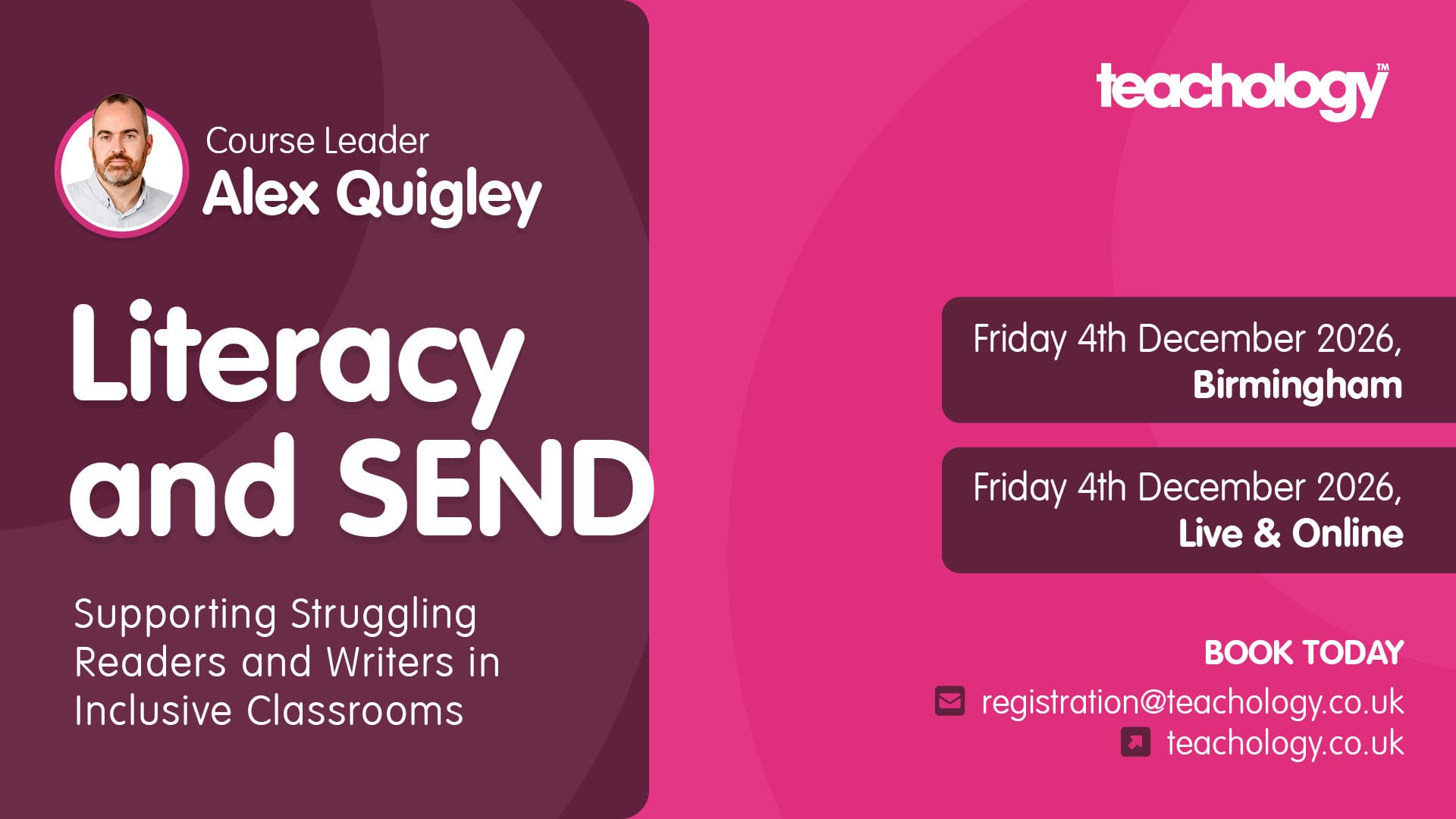
On the 4th December, I’m running my popular ‘Literacy and SEND’ Teachology Masterclass. It is both live, in Birmingham and online (with innovative interactive technology), with great resources & a copy of my new book. I’ve had feedback that schools are using their ‘Inclusive Mainstream Fund‘ for staff to attend the training. FIND OUR MORE HERE.

Comments